
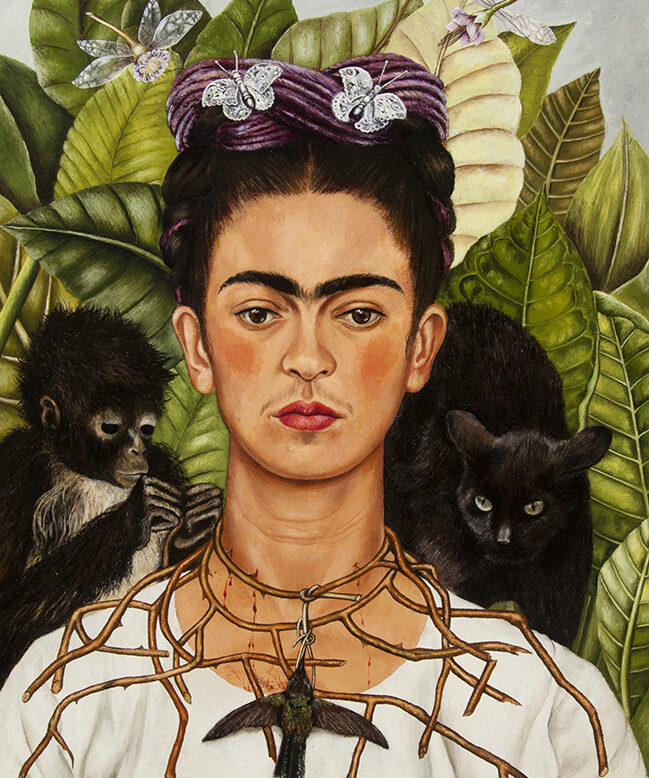
At the time of her death in 1954, Frida Kahlo was known to a confined circle of aficionados and collectors. She had had a mere handful of solo exhibitions and had sold few works. While she was a name, she was little more than that, notable mainly as the painter wife of a much more famous artist, Diego Rivera. She has had, however, a spectacular afterlife and is now, by some distance, the most celebrated female artist of all. Today she reigns as a secular saint, in both her native Mexico and beyond, the mater dolorosa of innumerable other artists, and a fetish figure for feminists, political activists, disability rights campaigners, LGBQT advocates and nationalist idealists everywhere. If you are feeling misunderstood, put upon, or even mildly oppressed then there’s a Frida there for you.
How she got this way is the subject of Tate Modern’s new exhibition “Frida: The Making of an Icon”. There is perhaps no other painter for whom the same formula would work – Leonardo? Monet? Jackson Pollock? They are just not quite right for that clanging, overused word “icon”. Kahlo’s beatification though has been rapid. She was first seen in Britain in 1953 as part of a show of contemporary Mexican art at the old Tate Gallery. By 2005 she was significant enough to have a big monographic exhibition at Tate Modern with some 80 works. Since then her celebrity has exploded further.
This latest exhibition is in fact very little to do with her art but rather her brand and what others have made of it – artistically and commercially. Such is the allure of her name and image that despite it featuring just 33 works by Kahlo herself the show has broken pre-sales records for the gallery. This is nevertheless a display that has adapted to circumstances. Since 1984, when Kahlo’s work was declared part of Mexico’s “national patrimony”, strict limits have been set on loan terms (a version of Tate’s exhibition has just closed in Houston after a four-month run which with Tate’s six month span would mean paintings being absent for a year); private lenders have been reluctant to part with works at a time of international instability (the Trump/Netanyahu war on Iran began at the very time shipping of works was being discussed); and Mexico wanted its major Kahlos in the country for the duration of the football World Cup. So, for example, Madonna – who owns four Kahlos (three per cent of the total known number) and lent to Tate’s previous show – is one of the private collectors who refused to contribute this time.
And while 33 pictures sounds a lot, only a handful can claim to rank among her best, and even they are greatly outnumbered by the work of 80 other artists, both her contemporaries and those at work today. She is therefore the Cheshire cat smile in the exhibition that bears her name. While the curators have cut their cloth accordingly, the exhibition is some way short of what it was conceived to be.

On its own terms, the development of the Kahlo brand, it is uneven too. There are a great number of supplementary works that have negligible aesthetic merit, variations of folk art in which other artists have simply borrowed Kahlo’s face or her pain as a form of visual shorthand that is easier than coming up with something of their own. This appropriation might be interesting if the results were of a higher quality, but pictures such as Miranda Bergman’s Tree of Hope, Stand Firm (1978) – a floral mandala with Kahlo at its centre – or various artists who have used her Two Fridas (1939 and not in the exhibition) – a double self-portrait with a mystical blood infusion – to show their split selves as gay, transvestite or physically damaged, are simply unmemorable.
Kahlo was, of course, complicit from the start. Her father was a photographer and she understood from him the potency of the camera. The exhibition has numerous photographs, informal and formal, that show how her impassive face, indigenous costumes, monobrow and incipient moustache were conscious elements of her self-image. There are many pictures of her with the monumentally porky Rivera too; however many infidelities and dalliances they chalked up between them (including catching Rivera in flagrante with her sister Cristina), the pictures state that they came as a package. Kahlo was never averse to someone poking a camera at her: the prosthetics and surgical corsets she wore to manage her polio-shortened leg and the broken spine she suffered in a catastrophic bus accident in 1925 were necessary aids but also functioned in the same way that saints have long been pictured with their symbols of martyrdom.
However, the best of her own pictures reinforce the distance between her work and that of her acolytes. For example, two self-portraits – Self-portrait with Thorn Necklace and Hummingbird (1940) and Self-portrait with Loose Hair (1947) – demonstrate how carefully, using her hair and accoutrements as emblems, she wove themes of Mexican history and identity, pre-Hispanic traditions and Christian symbols into her image. Here was a mestiza – mixed blood – woman who not only understood her heritage but was proud to advertise it.
The most unnerving of her paintings here is The Suicide of Dorothy Hale (1938-9). It was commissioned for Hale’s mother but shows the death of the socialite three times – jumping from her New York apartment window, in the act of falling through Chagall-like clouds, and on the ground, broken, bleeding and open eyed in death. Why Kahlo thought her gory, flick-book memorial (she even painted blood on the frame) would be an appropriate image to console a woman who had lost her daughter so distressingly is a mystery. While many of her works here are minor in the extreme this haunting picture shows why Kahlo could indeed be worthy of emulation.
Perhaps she succeeded too well in making a cult around herself. The reductio ad absurdum is a room devoted to some 200 objects of Kahlo merchandise. It is a tacky homage of mobile phone cases and egg cups, fridge magnets and lipstick cases. And of course the Frida Barbie doll that caused a rumpus when it appeared in 2018 and offended because Mattel had given her a European skin tone and tidied up her eyebrows and upper lip. Although whether a plastic doll was a suitable form of tribute in the first place seems not to have been pondered. On the other side of the door to this room is, of course, the museum shop.
It is a small step from Kahlo being an artistic commodity to a commercial one. The irony being that each use of her face and life story doesn’t cement her as an artist of note but distances her from her paintings. There are times in this show that the viewer will need to ask themselves whether she was ever an artist at all.
[Further reading: David Hockney was as serious as he was fun]
Content from our partners



Related

This article appears in the 01 Jul 2026 issue of the New Statesman, Happy Birthday America
Join the debate
Subscribe here to comment